1
Installation
Connect to cold water line
Water Filter | NSF Certified | Water Purifier


Understanding filtration systems helps you choose the right solution for UAE water conditions.
Water quality directly impacts your health, appliances, and daily comfort. In the UAE's unique environment, where desalination and varying TDS levels create specific challenges, choosing the right filtration system isn't just about preference—it's about protection. This guide walks you through proven technologies, real costs, and practical selection criteria to help you make an informed decision.
Water filtration systems remove contaminants, impurities, and unwanted substances from your water supply through physical barriers, chemical processes, or biological methods.
In the UAE, where tap water quality varies significantly and mineral content varies by location, these systems have become essential for homes and businesses.
The primary technologies include reverse osmosis (RO), activated carbon filtration, UV purification, and water softening—each addressing different water quality challenges you face in Dubai and across the Emirates.
According to the UAE Government, 42% of the country’s potable water comes from approximately 70 major desalination plants. The UAE’s water supply comes primarily from desalination plants, which can leave residual salts, chlorine, and other treatment chemicals.
Additionally, aging infrastructure in some areas introduces sediment, rust, and potential bacterial contamination.
Your water may taste metallic, leave white deposits on fixtures, or contain levels of total dissolved solids (TDS) that exceed comfortable drinking standards. Research on UAE water quality indicates that most tap water has a TDS range between 110–300 ppm, which is considered safe and drinkable, though some areas may experience higher levels.
Reverse Osmosis (RO) forces water through a semi-permeable membrane that blocks particles as small as 0.0001 microns. According to the U.S. Environmental Protection Agency, RO systems can remove up to 95-99% of dissolved salts, heavy metals, and contaminants. This technology is particularly effective for Dubai’s varying TDS water.
Activated Carbon Filtration uses porous carbon to adsorb chlorine, volatile organic compounds (VOCs), and odor-causing substances through chemical attraction. According to scientific research, activated carbon can have a surface area exceeding 3,000 square meters per gram, improving taste and smell but not removing dissolved minerals.
UV Sterilization exposes water to ultraviolet light at specific wavelengths (typically 254 nanometers) that destroys bacterial DNA. UV disinfection studies confirm that this technology eliminates 99.99% of microorganisms without adding chemicals or changing water taste.
Water Softeners exchange calcium and magnesium ions (which cause hardness) with sodium or potassium ions through ion-exchange resins, preventing scale buildup in pipes and appliances.
You should test your water before selecting a system.
High TDS readings (above 300 ppm) indicate the need for RO filtration. Chlorine smell or taste requires activated carbon. Bacterial concerns demand UV treatment. Hard water causing scale buildup calls for softening.
| System Type | Contaminants Removed | Flow Rate | Maintenance | Best For |
|---|---|---|---|---|
| Reverse Osmosis | Salts, heavy metals, bacteria, 95-99% TDS | 50-75 GPD | Membrane every 2-3 years | Drinking water, high TDS |
| Activated Carbon | Chlorine, VOCs, odors, sediment | High (whole-house capable) | Filter every 6-12 months | Taste/odor improvement |
| UV Sterilization | Bacteria, viruses, protozoa | Very high (no flow restriction) | Bulb annually | Microbiological safety |
| Water Softener | Calcium, magnesium (hardness) | High (whole-house capable) | Salt refill monthly | Scale prevention |
| Multi-Stage Systems | Comprehensive (combines above) | Moderate to high | Varies by stage | Complete water treatment |
RO systems represent the most thorough filtration available for residential and commercial use.
A typical RO unit includes pre-filters (sediment and carbon), the RO membrane, a storage tank, and a post-filter for final polishing. Water passes through multiple stages, with waste water (reject) flushed away to prevent membrane fouling.
Advantages: Removes the widest range of contaminants, produces very pure water (10-50 TDS), improves taste dramatically, and requires minimal energy (uses water pressure).
Disadvantages: According to EPA research, traditional RO systems can generate five gallons or more of reject water for every gallon of treated water produced, though newer efficient models achieve better ratios. The system removes beneficial minerals along with contaminants, has a slower production rate requiring a storage tank, and membrane replacement costs vary depending on quality and supplier.
You’ll find RO systems ideal when your primary concern is drinking water purity and you’re dealing with high dissolved solids.
Carbon filters work through adsorption—contaminants stick to the carbon’s massive surface area.
Available as granular activated carbon (GAC) or carbon block filters, these systems excel at removing chlorine and organic compounds.
Advantages: Excellent chlorine removal, improves taste and smell immediately, no water waste, high flow rates suitable for whole-house use, and relatively inexpensive filtration option.
Disadvantages: Doesn’t remove dissolved salts or minerals, ineffective against bacteria unless combined with other methods, filter capacity exhausts over time requiring replacement, and channeling can occur in GAC filters reducing effectiveness.
Carbon filtration serves you best as a point-of-entry system for your entire home or as a pre-treatment stage before RO. It’s particularly valuable in areas where municipal chlorination is heavy but TDS levels remain acceptable.
UV systems use germicidal lamps that emit ultraviolet-C radiation, which penetrates microorganism cell walls and disrupts their DNA, preventing reproduction.
Water flows through a chamber surrounding the UV bulb, receiving exposure as it passes. The process is instantaneous and adds nothing to your water.
Advantages: Kills 99.99% of bacteria and viruses without chemicals, no taste or odor change, extremely low operating cost (bulb uses 30-60 watts), no water waste, and maintains full water pressure.
Disadvantages: Requires clear water to work (particles can shield microorganisms), provides no residual protection after treatment, bulb intensity degrades requiring annual replacement, doesn’t remove chemical contaminants or dissolved solids, and needs electricity to function.
You should consider UV filtration essential if you’re using well water, experiencing bacterial contamination, or want insurance against potential waterborne pathogens. It’s typically installed as the final stage after sediment and carbon filtration.
Hard water contains elevated calcium and magnesium, measured in grains per gallon (gpg) or parts per million.
Water hardness varies across the UAE depending on location and source. Ion-exchange softeners swap these hardness minerals for sodium or potassium through resin beads that require periodic regeneration with salt.
Advantages: According to appliance protection research, water softeners can add 5-10 years to appliance lifespans by eliminating scale buildup in pipes, water heaters, and appliances. They reduce soap and detergent usage by 50-70%, make skin and hair feel softer, and protect expensive equipment like coffee machines and steam ovens.
Disadvantages: Adds sodium to water (concern for low-sodium diets), requires regular salt additions (typical household uses approximately 40 pounds monthly), regeneration process wastes water and creates brine discharge, doesn’t remove other contaminants, and softened water feels “slippery” which some find unpleasant.
Water softeners function best as whole-house systems installed at your main water line. They’re particularly valuable in Dubai villas and commercial facilities with expensive plumbing fixtures and water-using appliances.
Under-sink units represent the most popular residential choice, installed in your kitchen cabinet with a dedicated faucet for purified water.
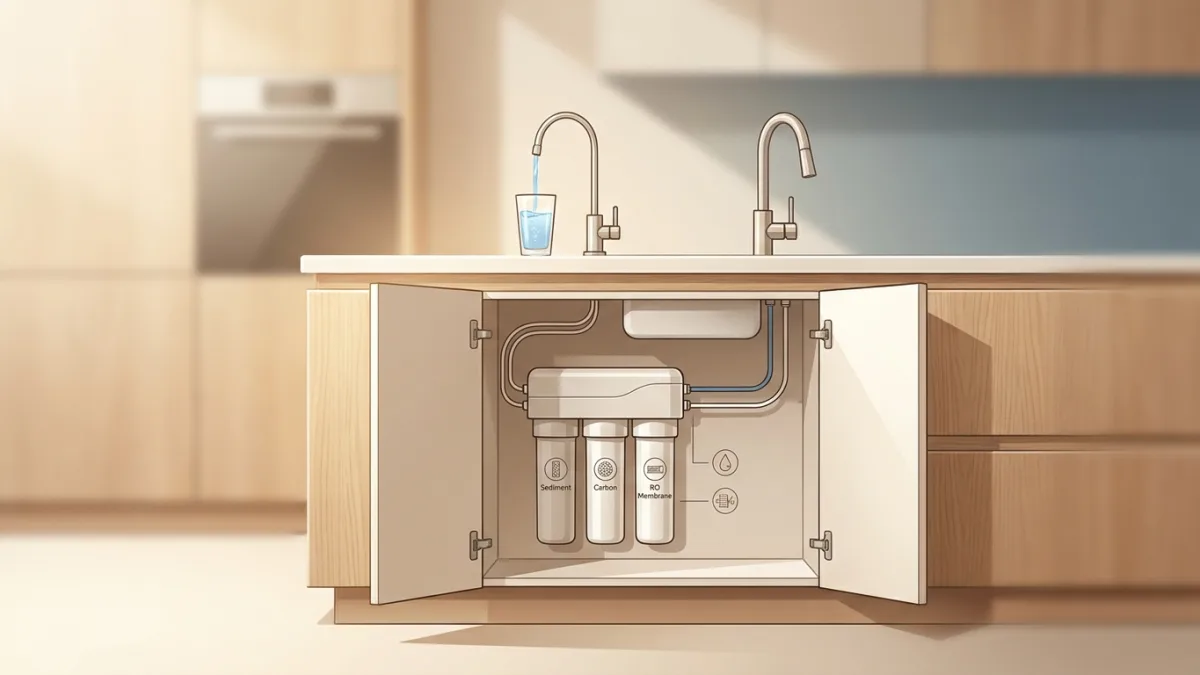
These compact systems typically feature 5-7 filtration stages including sediment pre-filter, carbon pre-filter, RO membrane, storage tank (8-12 liters), and post-carbon polishing filter.
Connect to cold water line
5-7 stages including membrane
Pre-filters every 6-12 months
RO membrane every 2-3 years
You’ll appreciate the convenience of unlimited purified water for drinking and cooking without buying bottled water. Installation takes 2-3 hours and connects to your cold water line with a drain connection for waste water.
Maintenance involves replacing pre-filters every 6-12 months and the RO membrane every 2-3 years. Annual service visits ensure optimal performance.
Whole-house systems install at your main water line entry point, treating all water entering your property.
These typically combine sediment filtration, activated carbon, and optionally water softening or UV sterilization. Flow rates must accommodate your entire household demand (typically 10-25 gallons per minute for UAE villas).
Configuration options include:
The primary advantage is consistent water quality throughout your home—every tap, shower, washing machine, and appliance receives filtered water. This protects your plumbing investment, improves bathing experience, and extends appliance life significantly.
For renters or those seeking minimal installation, countertop units connect directly to your kitchen faucet with a diverter valve, while pitcher filters require no installation at all.
These budget-friendly options provide basic filtration primarily through activated carbon.
Limitations to consider: Lower filtration capacity than RO systems, doesn’t significantly reduce TDS, limited flow rate, and frequent filter replacement (every 2-3 months for pitchers). These work adequately when your source water is already reasonable quality and you mainly want chlorine and taste improvement.
Many modern refrigerators include built-in water and ice dispensers with replaceable filters.
These typically use carbon block filtration to improve taste and reduce chlorine, sediment, and some contaminants. Filter cartridges require replacement every 6 months.
Important consideration: Refrigerator filters don’t reduce TDS significantly. If your UAE tap water has high dissolved solids, you’ll still experience scale buildup in the ice maker and water dispenser unless you install upstream RO or softening.
Commercial kitchens, cafes, and hotels require high-capacity filtration to serve customers and protect expensive equipment.
Coffee machines, ice makers, steamers, and dishwashers all perform better and last longer with proper water treatment.
Typical commercial configurations include:
A Dubai restaurant benefits from comprehensive water treatment through equipment protection, maintenance cost savings, and improved beverage quality that customers notice. Coffee shops particularly benefit from RO water, as mineral content dramatically affects espresso extraction and taste consistency.
Office buildings, medical facilities, and retail spaces need reliable water quality for drinking fountains, break rooms, restrooms, and cooling systems.
Building-wide solutions typically combine sediment filtration, carbon treatment, and water softening at the main supply, with point-of-use RO at drinking water locations.
Capacity considerations: A 50-person office might require a 100 GPD RO system for drinking water plus whole-building softening to protect HVAC systems and plumbing.
Manufacturing, laboratories, pharmaceuticals, and electronics production often require ultra-pure water beyond standard drinking water quality.
Industrial RO systems can produce water with less than 10 TDS, while additional deionization (DI) can achieve near-zero conductivity for sensitive processes.
Industrial system features:
Industrial installations require professional engineering to ensure optimal performance and compliance with industry standards.
Commercial pools and spas require specialized filtration combining mechanical filtration (sand or cartridge filters), chemical treatment (chlorination or salt systems), and increasingly UV or ozone sanitization.
The filtration system must turn over the entire pool volume multiple times daily.
Key components: Multi-port valve sand filters, cartridge filters for spas, UV systems for chemical reduction, and automated chemical dosing systems.
Water filtration systems range from simple DIY installations (pitcher filters, some countertop units) to complex installations requiring licensed plumbers.
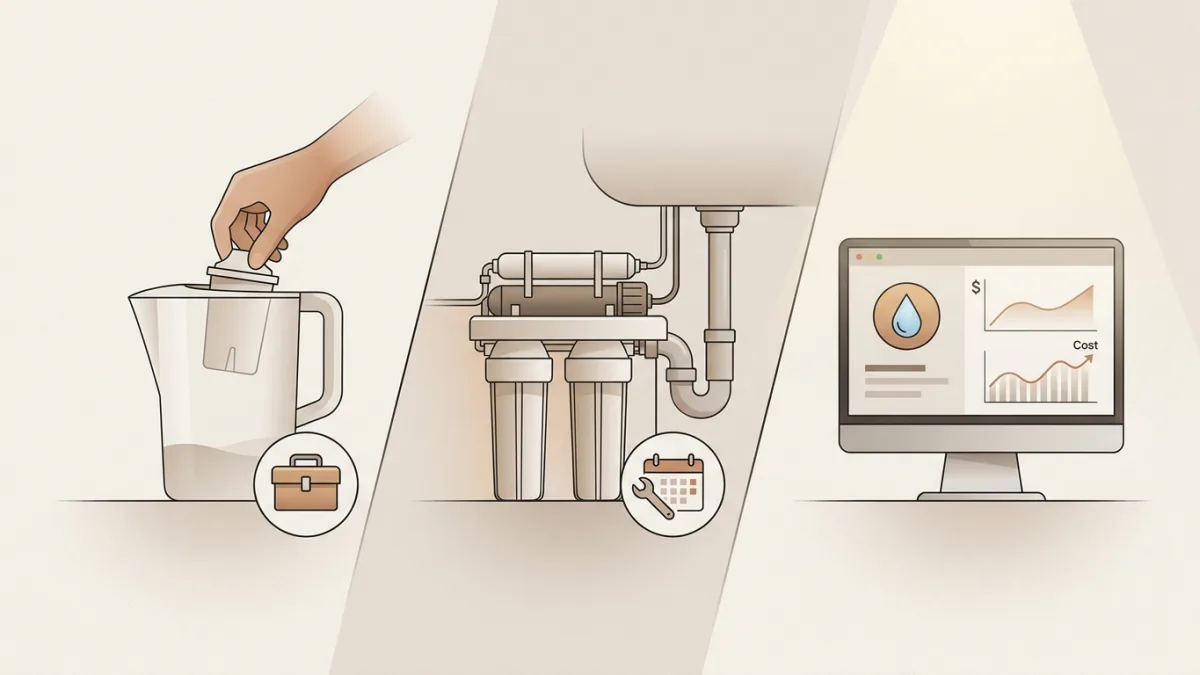
Under-sink RO systems fall in the middle—handy homeowners can install them, but professional installation ensures proper connections, leak prevention, and optimal performance.
Regular filter replacement prevents contamination and maintains effectiveness
Professional installation advantages: Warranty protection (many manufacturers require professional installation), proper drain connection preventing overflow, correct water pressure adjustment, system testing and verification, and compliance with UAE plumbing codes.
All filtration systems require periodic maintenance to function properly.
Neglected systems can become contaminated, lose effectiveness, or even make water quality worse than untreated supply.
Maintenance schedule by component:
| Component | Replacement Frequency | Consequences of Neglect |
|---|---|---|
| Sediment pre-filter | 6-12 months | Reduced flow, membrane damage |
| Carbon pre-filter | 6-12 months | Poor taste, membrane fouling |
| RO membrane | 2-3 years | High TDS, water waste increases |
| Post-carbon filter | 12 months | Taste degradation |
| UV bulb | 12 months | Bacterial growth risk |
| Softener resin | 5-10 years | Hard water breakthrough |
Many UAE water treatment companies offer annual maintenance contracts that include all filter replacements, system sanitization, and performance testing. This ensures optimal operation and extends system lifespan.
Beyond maintenance, you should consider ongoing operational expenses.
RO systems waste water during the filtration process. For a family using 10 liters of RO water daily with a traditional system, this means 30-40 liters of waste water, though newer efficient models can achieve better ratios.
Energy consumption varies by system type:
Cost-benefit perspective: According to cost comparison studies, a family of four could save $1,416 per year by switching from bottled water to a home filtration system, while enjoying unlimited purified water and eliminating plastic waste.
Quality water filtration systems, properly maintained, deliver 10-15 years of service.
The initial investment amortizes to a modest monthly cost when you factor in bottled water savings, appliance protection, and plumbing preservation.
Additionally, you’re protecting water heaters, washing machines, and plumbing fixtures worth thousands of dirhams from scale damage and premature failure.
Before investing in filtration, you should understand your specific water quality issues.
The Dubai Municipality and DEWA provide water quality reports, but conditions vary by building and neighborhood. A professional water test measures:
Interpreting results: TDS below 150 ppm is excellent, 150-300 acceptable, 300-500 needs improvement, above 500 requires RO filtration. Hardness above 7 gpg (120 ppm) causes noticeable scale. Chlorine above 2 ppm creates taste issues. Any bacterial detection requires immediate disinfection treatment.
For apartment residents: Under-sink RO systems provide purified drinking water without whole-house modifications landlords might prohibit. Add a shower filter if you experience dry skin or hair from chlorine.
For villa owners: Whole-house filtration with softening protects your entire plumbing investment. Combine with under-sink RO for drinking water, creating a comprehensive two-tier approach.
For families with young children: RO systems provide the safest drinking water by removing potential contaminants that affect developing immune systems. UV sterilization adds extra protection against waterborne pathogens.
For coffee and tea enthusiasts: Water quality dramatically affects beverage taste. RO water (remineralized slightly to 50-150 TDS) produces superior coffee and tea compared to high-TDS tap water or zero-TDS distilled water.
For those with health concerns: Low-sodium individuals should avoid traditional water softeners or choose potassium-based regeneration. Those with compromised immunity benefit from UV sterilization insurance.
System capacity must match your consumption patterns.
Under-sink RO systems typically produce 50-75 gallons per day (190-280 liters), adequate for drinking and cooking in most households. Commercial applications require higher-capacity systems or multiple units.
Flow rate matters for whole-house systems: Your main water line must deliver sufficient pressure (minimum 40 PSI for RO, 60 PSI optimal), and the system must handle peak demand when multiple fixtures operate simultaneously. A 4-bedroom villa might need 15-20 gallons per minute capacity.
Storage tank size affects convenience. Larger tanks (12-15 liters) provide more immediate purified water availability but take longer to refill. Smaller tanks (8-10 liters) refill faster but may run out during heavy use.
Water filtration systems range from budget imports to premium brands with proven track records. Key quality indicators include:
Membrane quality: Filmtec, Dow, and Toray produce industry-leading RO membranes with consistent performance. Generic membranes may have shorter lifespans and lower rejection rates.
Certification: Look for NSF/ANSI certifications (NSF 58 for RO systems, NSF 42 for carbon filters, NSF 55 for UV) indicating independent testing and verification.
Warranty coverage: Reputable manufacturers offer warranties on components and tanks. Warranty claims require professional installation documentation and regular maintenance records.
Local support: Systems from suppliers with UAE presence ensure you can obtain replacement parts, service, and technical support without international shipping delays.
Avoid common pitfalls: Extremely cheap systems often use inferior components that fail quickly. Similarly, overpriced systems making health claims beyond simple purification rarely justify their premium pricing.
Water filtration systems efficiently remove impurities, bacteria, and harmful chemicals from drinking water. By reducing exposure to contaminants such as chlorine, lead, heavy metals, and PFAS, these systems provide immediate protection for individuals and families. They reduce harmful contaminants in drinking water and make your water safer for your health. Filtered water removes toxins and contaminants, supporting a stronger immune system and helping the body fight illnesses more efficiently.
Replacement intervals vary by filter type and water conditions. Sediment and carbon filters typically need replacement every 3–6 months, RO pre and post filters every 6–12 months, and RO membranes every 2–3 years. The frequency depends on the type of filter and your water usage, with general recommendations to replace water filters every 12 to 24 months to ensure optimal performance. Regular maintenance ensures consistent water quality and extends system longevity.
Reverse osmosis systems dominate for overall contaminant removal. RO systems push water through a semipermeable membrane that blocks particles and contaminants, while carbon filters use activated carbon to improve taste and remove chlorine and VOCs. Reverse osmosis systems can filter down to 0.001 micron, which is 500 times smaller than most carbon filters. While carbon filters remove around 10–15% of TDS, reverse osmosis removes up to 97%.
Water filtration systems offer significant long-term savings. A typical family of four spending on bottled water can save between $1,162 to $2,331 per year by switching to a home filtration system. A high-quality water filtration system can last between 15 and 25 years if properly maintained. Beyond cost savings, filtration systems reduce plastic waste and provide unlimited clean water on demand.
Different water filters have different functions. Some make your water taste better, others remove harmful chemicals, and others remove certain germs, but filters cannot remove some types of harmful substances. Reverse osmosis systems performed most consistently, with all tested RO models achieving at least 90% PFAS removal. Activated carbon on its own cannot remove bacteria, viruses, fluoride, heavy metals, or dissolved solids found in tap water. Choosing the right system depends on your specific water quality concerns.
Whole-house systems include pre-filters, main filters, and post-filters, each with different replacement schedules. The lifespan of a main filter can vary widely, lasting anywhere from 1 to 10 years. Replace sediment and carbon filters on whole-house and under-sink systems every 3–6 months, and in high-sediment areas, shorten to 1–3 months. For most residential systems, flushing every 4-6 weeks is recommended, with homes having higher water usage requiring more frequent flushing.
While UAE tap water meets WHO standards, filtration improves taste and removes chlorine. Filtration reduces TDS (Total Dissolved Solids) and protects appliances from scale, with hard water being particularly problematic in the UAE, making filtration and softening highly beneficial. Tap water in the UAE is safe but can contain chlorine, sediments, and impurities that affect taste, and water filters ensure cleaner, fresher, and better-tasting drinking water. Professional installation is recommended to ensure optimal performance in local water conditions.