1
Preparation
Shut off water and drain lines
Water Filter | NSF Certified | Water Purifier


Everything you need to know about choosing and installing water filters in Dubai.
Living in Dubai, you've probably wondered whether your tap water needs additional filtration. DEWA's supply is safe, but building tanks and aging pipes can compromise quality. Here, I'll show you exactly which filtration systems work best for Dubai's unique desalinated water, what to expect in terms of costs, and how to select the right solution for your home or business.
Dubai’s water supply presents unique challenges that make filtration systems essential for residents and businesses. The emirate sources approximately 99% of its drinking water from desalinated seawater, with the remainder coming from underground aquifers. According to the Dubai Electricity and Water Authority (DEWA), tap water is safe to drink and meets World Health Organization standards before distribution, but the journey from treatment plants to your tap can introduce contaminants.
The UAE employs two main desalination technologies: thermal desalination (Multi-Stage Flash and Multi-Effect Distillation) and reverse osmosis. The desalination process removes salt but doesn’t eliminate all dissolved solids, and the extensive pipeline network—some sections dating back decades—can introduce rust, sediment, and mineral deposits.
Additionally, building storage tanks, common in Dubai’s high-rise architecture, can harbor bacteria if not properly maintained. These factors create a compelling case for point-of-use filtration, particularly for vulnerable populations including children, elderly residents, and those with compromised immune systems.
Dubai’s tap water typically contains total dissolved solids (TDS) ranging from 70-120 mg/L, well within the WHO recommended maximum of 500 ppm. While technically safe, this mineral content affects taste and can leave deposits on appliances and fixtures.
Chlorine residue remains another concern. DEWA adds chlorine to prevent bacterial growth during distribution, with residual chlorine maintained between 0.2-0.5 mg/L for disinfection. Though within safe limits, many residents find the taste and odor unpleasant. Long-term exposure to chlorinated water may also affect skin and hair health, particularly in Dubai’s already dry climate.
Critical Point: While water supplied by DEWA is safe, issues may arise from internal building plumbing systems or poorly maintained water storage tanks. Buildings without regular tank cleaning can develop biofilm, rust particles, and even bacterial colonies that compromise water quality at the final delivery point.
Water hardness varies across Dubai’s different communities. Areas like Dubai Marina and Downtown Dubai typically receive water with newer infrastructure and more frequent maintenance. Older neighborhoods such as Deira and Bur Dubai often experience harder water with higher mineral content.
Dubai’s water is classified as hard, with calcium and magnesium content that causes scale buildup in pipes, reduces appliance efficiency, and creates that familiar white residue on bathroom fixtures and glassware.
The Dubai market offers diverse filtration technologies, each addressing specific water quality concerns. Understanding these systems helps you select the most appropriate solution for your needs and budget.
Reverse osmosis represents the gold standard for comprehensive water purification in Dubai. These systems force water through a semi-permeable membrane with pores approximately 0.0001 microns in size, removing up to 99% of dissolved solids, heavy metals, bacteria, and viruses.
RO systems typically feature five to seven filtration stages: sediment pre-filter, carbon pre-filter, RO membrane, post-carbon filter, and remineralization stage. The sediment filter removes particles larger than 5 microns, protecting the expensive RO membrane. Carbon filters eliminate chlorine, organic compounds, and odors that affect taste.
Advantages of RO systems:
Considerations:
Carbon filters excel at removing chlorine, volatile organic compounds (VOCs), and improving taste and odor. These systems use activated carbon—typically coconut shell or coal-based—with a massive surface area that traps contaminants through adsorption.
Available in multiple configurations including countertop units, under-sink systems, and whole-house filters, carbon filtration provides an economical solution for basic water quality improvement. Granular activated carbon (GAC) filters offer higher flow rates, while carbon block filters provide superior contaminant reduction due to longer contact time.
Carbon filters effectively remove chlorine, pesticides, herbicides, and industrial solvents. However, they don’t eliminate dissolved minerals, heavy metals, or microorganisms. For Dubai’s desalinated water, carbon filtration works best as a pre-treatment stage or for households primarily concerned with taste and chlorine removal.
Ultraviolet purification uses UV-C light at 254 nanometers wavelength to destroy bacteria, viruses, and other microorganisms by disrupting their DNA. A UV lamp housed in a stainless steel chamber treats water as it flows past, providing chemical-free disinfection.
UV systems shine in situations where biological contamination poses the primary concern—particularly relevant for buildings with questionable storage tank maintenance. They require minimal maintenance beyond annual lamp replacement and don’t alter water taste, pH, or mineral content.
Important: UV purification doesn’t remove dissolved solids, chlorine, or sediment. It works best combined with other filtration methods, particularly in multi-stage systems.
While technically not filters, water softeners address Dubai’s hard water challenges through ion exchange. These systems replace calcium and magnesium ions with sodium ions, preventing scale formation and extending appliance lifespan.
Whole-house softeners protect water heaters, washing machines, dishwashers, and plumbing fixtures from scale damage. In Dubai’s climate, where air conditioning condensate drains and cooling systems operate year-round, preventing scale buildup delivers substantial maintenance savings.
Modern softeners feature demand-initiated regeneration, using salt and water only when necessary rather than on fixed schedules. This efficiency matters in Dubai, where water conservation increasingly concerns residents and authorities alike.
Choosing an appropriate water filter requires evaluating your specific situation, water quality concerns, budget, and household requirements. Dubai’s diverse housing stock—from studio apartments to sprawling villas—demands different filtration approaches.
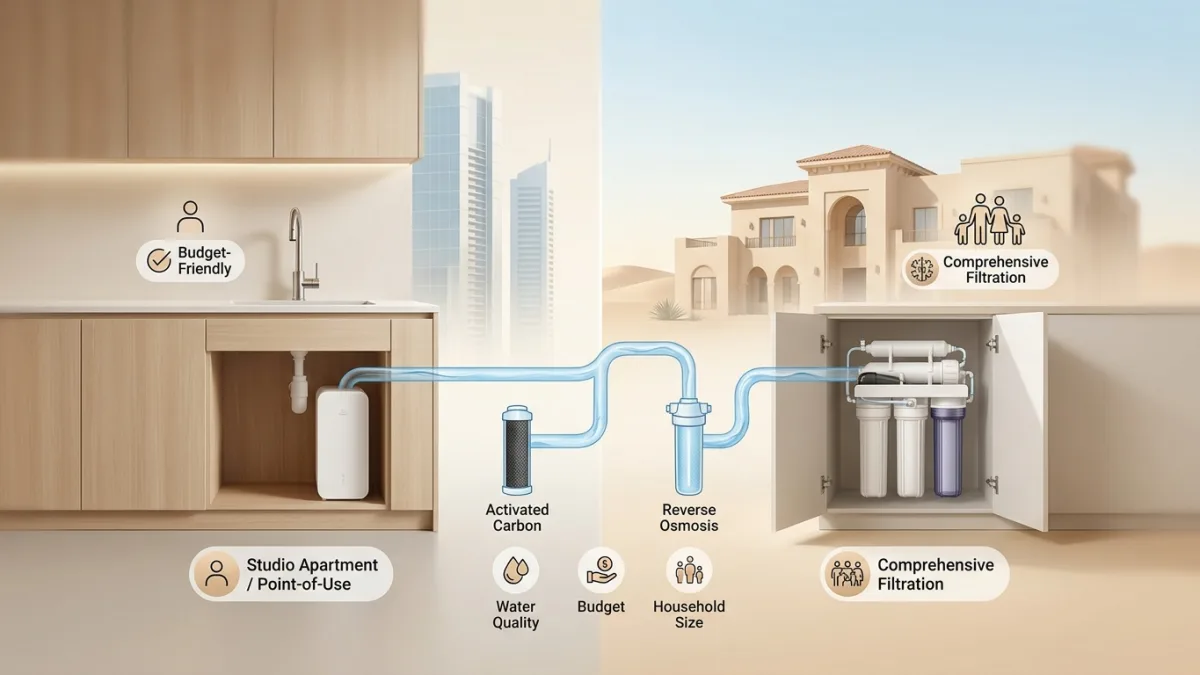
For apartments and small homes (1-3 bedrooms):
Under-sink RO systems provide the most practical solution, delivering purified water at the kitchen tap for drinking and cooking. A 5-7 stage RO system with 50-75 gallons per day (GPD) capacity serves most households adequately. Installation requires minimal space under the sink and a dedicated faucet.
Pair your RO system with a countertop or pitcher filter for additional convenience, or consider a direct flow RO system that eliminates the storage tank, saving space in compact kitchens.
For villas and larger homes (4+ bedrooms):
Whole-house filtration systems make sense for comprehensive protection. A multi-stage approach works best: sediment filter at the main line entry point, followed by carbon filtration, then point-of-use RO systems at kitchen taps. Add water softeners if your area experiences particularly hard water.
Larger properties benefit from commercial-grade RO systems with 100-300 GPD capacity, ensuring adequate purified water supply for multiple family members and guests.
Restaurants, cafés, and hotels require robust filtration to protect reputation and comply with health regulations. Commercial RO systems with capacities from 500 GPD to 5,000+ GPD handle high-volume demands while maintaining consistent water quality.
Food service establishments should prioritize systems with NSF/ANSI 58 certification, ensuring they meet strict safety and performance standards. Ice machines, coffee equipment, and steam ovens particularly benefit from filtered water, producing better-tasting beverages and reducing maintenance frequency.
Manufacturing facilities and laboratories need customized solutions based on specific water quality requirements. Pharmaceutical production might demand specialized purified water, achievable through multi-pass RO systems with additional treatment stages.
| System Type | Initial Cost (AED) | Annual Maintenance | Lifespan | Best For |
|---|---|---|---|---|
| Basic Carbon Filter | 300-800 | 200-400 | 3-5 years | Taste improvement |
| Under-Sink RO (5-stage) | 1,200-2,500 | 400-700 | 5-7 years | Drinking water |
| Premium RO (7-stage) | 2,500-4,500 | 500-900 | 7-10 years | Complete purification |
| Whole-House System | 5,000-15,000 | 1,000-2,000 | 10-15 years | Comprehensive protection |
| Water Softener | 3,000-8,000 | 600-1,200 | 10-15 years | Hard water areas |
Budget for replacement filters, membranes, and UV lamps as ongoing costs. Quality systems from reputable suppliers include service packages that simplify maintenance scheduling and ensure optimal performance throughout the system’s lifespan.
Before investing in filtration equipment, conduct water testing to identify specific contaminants and quality issues. DEWA provides free water quality reports upon request, showing basic parameters like pH, TDS, and chlorine levels.
For comprehensive analysis, private laboratories in Dubai offer testing packages. Tests typically measure:
Results guide your filtration system selection, ensuring you address actual problems rather than perceived concerns. A property with primarily taste and odor issues wastes money on expensive RO systems when carbon filtration suffices.
Proper installation determines filtration system performance and longevity. Dubai’s unique building codes, water pressure variations, and climate conditions require professional expertise for optimal results.
Professional installers begin with a thorough property assessment. They measure water pressure at installation points—critical because RO systems require minimum 40-60 PSI for efficient operation. Low-pressure situations, common in upper floors of older buildings, necessitate booster pumps.
Shut off water and drain lines
Mount system and connect lines
Pressure test and check for leaks
Test water quality with TDS meter
Space availability dictates system selection. Under-sink installations need adequate clearance for filter housings, storage tanks, and future maintenance access. Whole-house systems require protected outdoor locations or dedicated utility spaces with proper drainage.
Plumbing configuration affects installation complexity and cost. Modern PEX or copper plumbing simplifies connections, while older galvanized pipes may require additional adapters or even partial re-piping to prevent contamination from corroded pipes.
Dubai Municipality and local authorities regulate water system modifications, particularly for commercial properties. Residential installations typically don’t require permits, but commercial establishments must ensure compliance with health and safety regulations.
Food service businesses must submit water quality reports and filtration system specifications during health license applications and renewals. Systems must meet Dubai Municipality’s standards for food preparation water quality.
Building management approval becomes necessary for modifications affecting shared plumbing infrastructure. Obtain written permission before installing whole-house systems or making alterations to main water lines in multi-unit buildings.
Quality installation follows systematic procedures ensuring leak-free operation and optimal performance. Experienced technicians complete residential installations within 2-4 hours, while commercial systems may require full-day or multi-day projects.
Standard installation steps include:
Quality Check: Reputable installers provide TDS meter readings before and after installation, documenting the system’s contaminant reduction performance from day one.
Regular maintenance preserves filtration efficiency and extends system lifespan. Establish service schedules based on manufacturer recommendations and actual water usage patterns.
Typical maintenance intervals:
Dubai’s water quality and climate conditions may accelerate filter degradation. High TDS levels clog sediment filters faster, while dust infiltration in less-sealed systems reduces carbon filter effectiveness. Monitor filter condition through pressure gauges and flow rate changes rather than relying solely on time-based schedules.
Service providers in Dubai offer annual maintenance contracts (AMCs) covering scheduled filter replacements, system inspections, and emergency repairs. AMC costs range from AED 400-1,500 annually depending on system complexity, providing peace of mind and ensuring consistent water quality.
Dubai’s water treatment market features international brands and local specialists offering diverse products and service levels. Understanding the competitive landscape helps you identify reliable suppliers and avoid substandard equipment.
Global manufacturers maintain strong presence in Dubai through authorized distributors and service centers. These brands invest heavily in research and development, offering advanced filtration technologies with proven track records.
American brands like Pentair, Culligan, and 3M dominate the commercial and industrial sectors with high-capacity systems and comprehensive certifications. Their products typically carry NSF International certifications for specific contaminant reduction claims, with RO systems certified to NSF/ANSI 58 for removing TDS, hexavalent chromium, cysts, fluoride, arsenic, and nitrates, providing third-party verification of performance.
European manufacturers including BWT and Aquaphor focus on residential markets with compact, design-conscious systems that appeal to Dubai’s aesthetically-minded consumers. German engineering excellence translates to durable components and efficient operation.
Asian brands, particularly from South Korea and Japan, offer competitive pricing with increasingly sophisticated technology. Companies like Coway and Panasonic incorporate smart features including real-time water quality monitoring and automated filter replacement alerts.
UAE-based companies specialize in solutions tailored to local water conditions and climate challenges. These providers understand Dubai’s specific requirements—from dealing with high TDS desalinated water to operating in extreme summer temperatures.
Local specialists offer advantages including rapid response times, readily available spare parts, and technicians familiar with Dubai’s building types and plumbing configurations. Many provide same-day service for emergencies and maintain extensive inventories of compatible filters and components.
Regional providers often customize international products for local conditions, adding pre-filtration stages for Dubai’s sediment-heavy water or upgrading UV systems to handle higher bacterial loads in buildings with aging infrastructure.
Select suppliers based on comprehensive criteria beyond initial pricing. Long-term satisfaction depends on service quality, parts availability, and technical support.
Key evaluation factors:
Request detailed quotations including all costs—equipment, installation, commissioning, and first-year maintenance. Hidden costs for “optional” components or inflated filter replacement prices indicate questionable business practices.
Comprehensive warranties protect your investment and signal supplier confidence in product quality. Standard warranties cover manufacturing defects, while extended warranties may include wear components and performance guarantees.
Typical warranty structures:
Premium suppliers offer performance guarantees, promising specific contaminant reduction levels throughout the warranty period. If the system fails to meet specifications, they repair or replace components at no charge.
After-sales support quality varies dramatically. Test responsiveness by calling with technical questions before purchasing. Suppliers who provide knowledgeable answers and helpful guidance typically maintain that service quality post-sale.
Understanding the complete financial picture—from initial purchase through years of operation—enables informed decisions that balance quality, performance, and budget constraints.
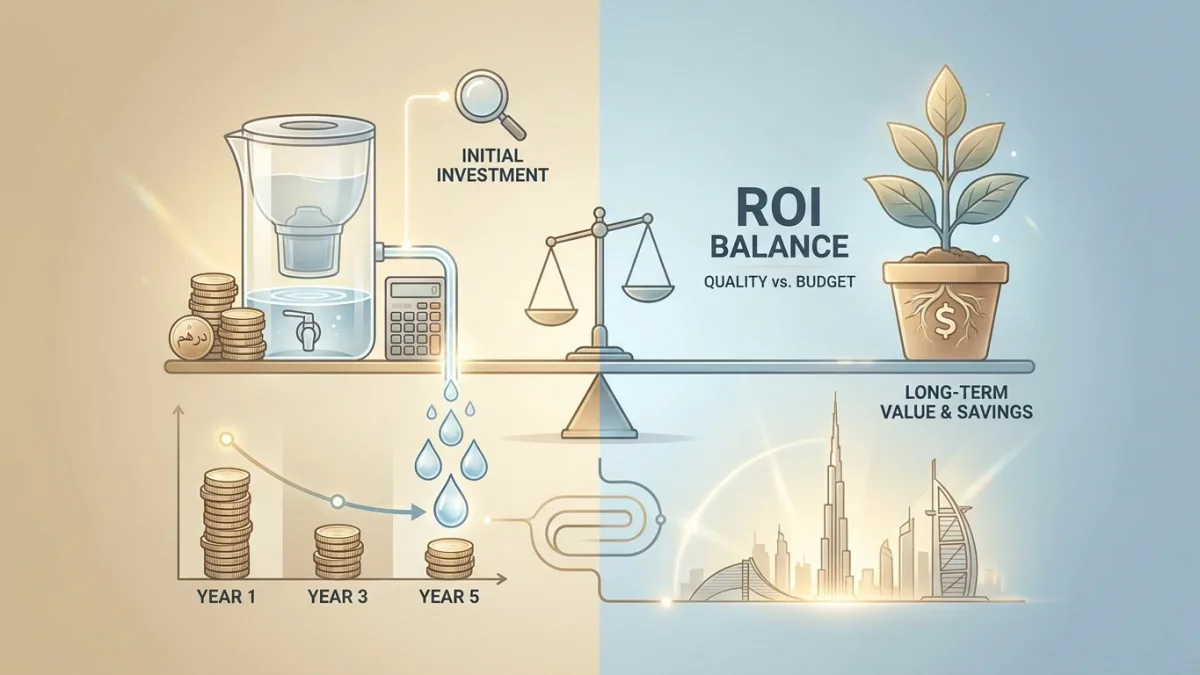
Water filtration system costs encompass equipment, installation, and commissioning. Dubai’s competitive market offers options across all price ranges, though quality and longevity correlate strongly with investment level.
Buildings without regular tank cleaning can develop biofilm, rust particles
Residential system costs:
Commercial system costs:
Installation adds 15-30% to equipment costs for residential systems, potentially more for complex commercial installations requiring electrical work, drainage modifications, or structural changes.
Ongoing expenses include filter replacements, membrane changes, electricity consumption, and water wastage (for RO systems). Calculate five-year total cost of ownership rather than focusing solely on purchase price.
| Cost Component | Annual Expense (AED) | Notes |
|---|---|---|
| Sediment filters (4/year) | 120-200 | Higher in dusty areas |
| Carbon filters (2/year) | 200-400 | Quality affects lifespan |
| RO membrane (every 2-3 years) | 200-300 | Amortized annually |
| UV lamp replacement | 150-250 | Annual replacement |
| Electricity (RO pump) | 50-100 | Based on 50 GPD usage |
| Water wastage cost | 100-200 | Traditional systems |
| Annual service visit | 200-400 | Optional but recommended |
| Total Annual Cost | 1,020-1,850 | For typical 5-stage RO |
Compare these costs against bottled water expenses. A family consuming five 5-liter bottles weekly (common in Dubai) spends approximately AED 2,600-3,900 annually. Filtered tap water achieves payback within 1-2 years while eliminating plastic waste.
Factor in less obvious expenses and benefits when calculating ROI. Appliance protection delivers substantial savings for properties with hard water.
Water heaters in Dubai typically last 5-7 years before scale buildup causes failure. Softened or filtered water extends lifespan to 10-15 years, saving AED 2,000-4,000 in replacement costs. Washing machines, dishwashers, and coffee makers similarly benefit from scale-free water.
Reduced detergent and soap consumption provides ongoing savings. Hard water requires more cleaning products to achieve the same results, while soft water lathers easily and rinses cleanly. Households report reductions in cleaning product purchases.
Energy efficiency improves when appliances operate scale-free. Water heaters with mineral buildup require more energy to heat water, while clean heating elements transfer heat efficiently.
Beyond financial calculations, water filtration delivers environmental and health benefits that enhance quality of life in Dubai.
Plastic waste reduction represents a significant environmental contribution. Dubai residents consume enormous quantities of bottled water, generating plastic waste that burdens landfills and recycling systems. A single household switching to filtered tap water eliminates hundreds of plastic bottles annually.
Health improvements from contaminant-free water prove difficult to quantify financially but matter tremendously. Reduced exposure to chlorine, heavy metals, and potential biological contaminants supports long-term wellness, particularly for children and vulnerable individuals.
Perspective: While ROI calculations focus on measurable costs and savings, the peace of mind from knowing your family drinks pure, safe water throughout every day carries immeasurable value.
Modern water filtration systems incorporate digital technologies that enhance convenience, optimize performance, and provide real-time water quality information.
Internet-connected filtration systems transmit performance data to smartphone applications, enabling remote monitoring and proactive maintenance. These smart systems track filter lifespan, water consumption, and quality parameters continuously.
Advanced models feature TDS sensors that measure total dissolved solids in real-time, alerting you when filter performance degrades below acceptable thresholds. This data-driven approach replaces guesswork with precise filter replacement timing, optimizing costs while maintaining water quality.
Flow meters integrated into smart systems calculate exact water usage, helping Dubai households monitor consumption and identify leaks quickly. Given DEWA’s tiered pricing structure, usage awareness can reduce water bills significantly.
Smart filtration systems send notifications when filters require replacement, eliminating calendar-based reminders and preventing forgotten maintenance. Alerts arrive via mobile app, email, or SMS based on actual usage and filter condition rather than arbitrary time intervals.
Some premium systems automatically order replacement filters when needed, coordinating delivery with your schedule. This subscription-based approach ensures you never run out of filters while potentially securing volume discounts from suppliers.
Diagnostic alerts warn of system malfunctions—low pressure, membrane damage, or UV lamp failure—before they compromise water quality. Early detection prevents drinking contaminated water and reduces repair costs by addressing issues promptly.
Recent innovations reduce the environmental impact and operating costs of water filtration systems. Tankless RO systems eliminate the traditional storage tank, using direct-flow technology that purifies water on demand. These systems reduce water waste and save space while maintaining adequate flow rates for drinking and cooking.
Energy recovery devices in commercial RO systems capture pressure from reject water, with modern systems achieving energy consumption as low as 2.9 kWh/m³, representing a 35% reduction over the past decade—significant for high-capacity installations operating continuously.
Solar-powered filtration systems suit Dubai’s abundant sunshine, particularly for standalone applications like swimming pool filtration or agricultural water treatment. While residential drinking water systems typically require grid power for reliability, solar options exist for environmentally conscious consumers willing to invest in battery backup.
Touchscreen displays and intuitive controls make modern filtration systems accessible to all household members. Visual indicators show filter status, water quality, and system operation at a glance.
Digital faucets with integrated displays present water quality information in real-time, showing TDS levels, temperature, and filter lifespan remaining. Some models offer preset dispensing volumes—perfect for filling water bottles or measuring cooking water precisely.
Voice control integration with Amazon Alexa or Google Assistant enables hands-free operation, though this remains a premium feature in high-end systems. More practical are one-touch dispensing modes for common volumes like 250ml, 500ml, or 1 liter.
IoT-enabled water systems collect usage data and potentially personal information through user accounts. Select manufacturers with clear privacy policies and secure data handling practices.
Ensure smart systems use encrypted communications when transmitting data to cloud servers. Local network security matters too—change default passwords and keep firmware updated to prevent unauthorized access.
For commercial installations, data ownership and access rights require contractual clarity. Verify whether usage data remains your property or becomes available to the manufacturer for analytics and marketing purposes.
While Dubai’s tap water meets WHO safety standards at the source, a water filter provides valuable additional protection. The primary concern is not the municipal supply itself, but potential contamination from building storage tanks and internal plumbing systems. Installing a quality filter improves water clarity, taste, and odor while removing residual chlorine, sediment, and trace contaminants that may accumulate during distribution. For families prioritizing health and water quality, filtration offers essential peace of mind.
Yes, approximately 99% of Dubai’s drinking water comes from desalinated seawater processed by DEWA through sophisticated treatment protocols. The purification process uses advanced reverse osmosis and thermal desalination methods (Multi-Stage Flash and Multi-Effect Distillation) to remove salts and impurities from Arabian Gulf seawater. DEWA follows strict international standards, ensuring water meets World Health Organization guidelines and conducts regular testing. However, water quality can be affected by building infrastructure before reaching your tap.
The UAE employs two primary desalination technologies: thermal desalination and reverse osmosis. Reverse osmosis uses high-pressure pumps to force seawater through semi-permeable membranes, filtering out salt and impurities as a more energy-efficient alternative. Thermal methods like Multi-Stage Flash (MSF) and Multi-Effect Distillation (MED) heat seawater until it vaporizes, then condense the steam into freshwater. Post-treatment includes chlorination and monitoring to ensure microbiological safety throughout the distribution network.
Reputable brands consistently receive high performance ratings in independent testing. Established manufacturers like AquaTru, Clearly Filtered, and SpringWell are recognized for quality, alongside well-known brands like Aquasana. The best choice depends on your specific needs and water quality concerns. Reverse osmosis systems are particularly popular in Dubai for removing dissolved salts, heavy metals, and microbes while significantly improving taste, with RO technology removing up to 99% of contaminants. Consider certifications from NSF International, Water Quality Association (WQA), or International Association of Plumbing and Mechanical Officials (IAPMO) when selecting your system.
Water filters effectively eliminate impurities such as chlorine, sediment, heavy metals, and contaminants commonly found in desalinated water. Installing a filtration system leads to long-term cost savings compared to purchasing bottled water regularly, eliminating single-use plastic bottles and associated expenses. Filtering water at the point of use ensures your family benefits from water free of pollutants originating from plumbing or distribution systems, especially crucial for households with children, elderly members, or individuals with sensitive health conditions. Additionally, filters provide better-tasting water for drinking and cooking.
According to Dubai Municipality regulations, water storage tanks must be cleaned at least every six months. All residential and commercial water tanks must be cleaned at least every six months, with major-use facilities such as shopping malls, hospitals, and hotels requiring more frequent cleaning based on usage. Inspections increased to quarterly in 2024 updates, with mandatory documentation of dates, methods, and providers. Regular cleaning is extremely important because old pipes and poorly maintained tanks can introduce contaminants, affecting water quality even when the municipal supply is safe. Residents should ask landlords or property managers about tank maintenance schedules to ensure optimal water safety.
Reverse osmosis systems are highly effective in Dubai, removing dissolved salts, heavy metals, and microbes through multiple filtration stages. RO systems force water through semipermeable membranes, effectively removing dissolved salts, heavy metals, and other contaminants. UV purifiers use ultraviolet light to inactivate or kill bacteria, viruses, and cysts in contaminated water, and combining UV purification with other filtration methods is popular among health-conscious consumers. Always verify that your chosen filter meets specifications and has appropriate certifications for contaminant removal.